Often, random and seemingly unrelated things can help us to examine and explore User Experience and Product Design from a new perspective. In this new series, we take a single idea, event, or situation and explore what it can teach us.
What are we talking about?: The VHS vs. Betamax wars
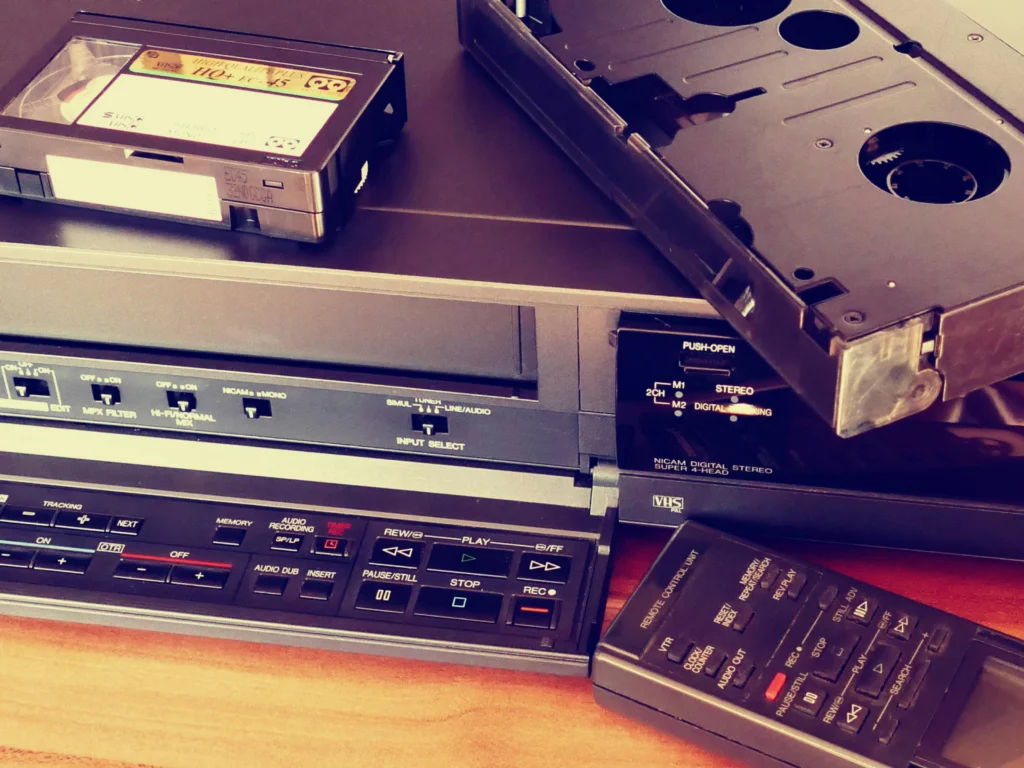
In 1975, Sony released its new home video cassette recorder (VCR) format – Betamax. It was swiftly followed by JVC’s own version – VHS. So began the so-called “format wars.” Both formats, alongside a number of other lesser competitors, battled for primacy in this brand-new market. Objectively speaking, the Betamax format provided better picture and sound quality, and machines were considered to possess better construction quality. Even now, many videophiles will tell you (at length) about how Betamax was the better format. However, VHS won the war, despite its shortcomings in terms of quality. There have been many discussions on what truly led to its success, but two factors stand out – price and recording time. VHS was priced more competitively than its rivals – and quite vitally, at launch, it provided tapes with a recording time of 120 mins against Betamax’s 60 mins. By 1987 VHS accounted for over 90% of the home VCR market, and Betamax was effectively done. Although, both formats were later superseded by DVD.
What do we learn?
Whilst the tale of the format wars is often viewed as one of business and marketing. However, there are parallels we can make to UX and Product design.
Know what users need to do
Running time is widely seen as a critical issue for Betamax. The platform’s 60min running time was taken from broadcast industry standard Numatic tapes – they essentially produced a home version to industry specs. However, industry user needs were not the same as home user needs. 60mins may be fine for broadcast industry needs, but it won’t record a baseball game or a movie. This was an important factor for a home user, and no amount of superior quality would replace the inability to record the latest football game. VHS offered an alternative that actually met user needs. Some exploration into user needs – even in a new market – could have helped Sony to understand this critical issue.
First is good, but only if it’s right
Betamax launched quickly into a new market to establish its dominance – but at the expense of fully understanding its new users and needs. As such, VHS took over market share. Betamax would eventually try to fix these issues – reducing price and increasing recording time – but it was too late. Too often, products are released quickly to get to market quickly – the often completely misapplied “MVP” – with a view to iterating and improving continually post-launch. There’s nothing wrong with iteration – ongoing product evolution is vital – but never at the expense of providing a product or service that works for users in the first place. First experiences count – and it’s tough to persuade a user who’s been burnt by a poor experience to return. This is because, in many cases, you can be driving them into the arms of your competitors, who – if they’re canny – will have understood their needs more effectively and provide a superior alternative.
Conclusion
I’d heartily recommend falling down an internet rabbit hole about the format wars – there are so many more fascinating details and explorations out there. Some UX takeaways from the story we’ve found include:
- Understanding your users is vital, regardless of whether you’re in an established or brand-new market. Research and investigate the true needs of your users.
- Don’t assume needs from other ‘similar’ or existing users.
- By all means, work to put out your product quickly, but never at the expense of actually understanding and meeting user needs.
- Iteration is good, but you won’t always get a second chance if you dissatisfy users in the first place.